
Every provider promises deliverability and a good price. These twelve questions show you how solid each provider’s operation really is, and spare you surprises after signing.
Why the choice matters more than it looks
The SMS provider is the last link between your system and the customer handset. If it fails, your OTP does not arrive, your alert is delayed, your campaign is blocked. And unlike other services, the problems tend to surface at the worst moments: at the traffic peak, during the important campaign, at month end. Choosing well is an operational and risk decision, not just a procurement one.
These twelve questions cover infrastructure, functionality, security, service and commercial terms. Ask all of them before signing.
Infrastructure and delivery
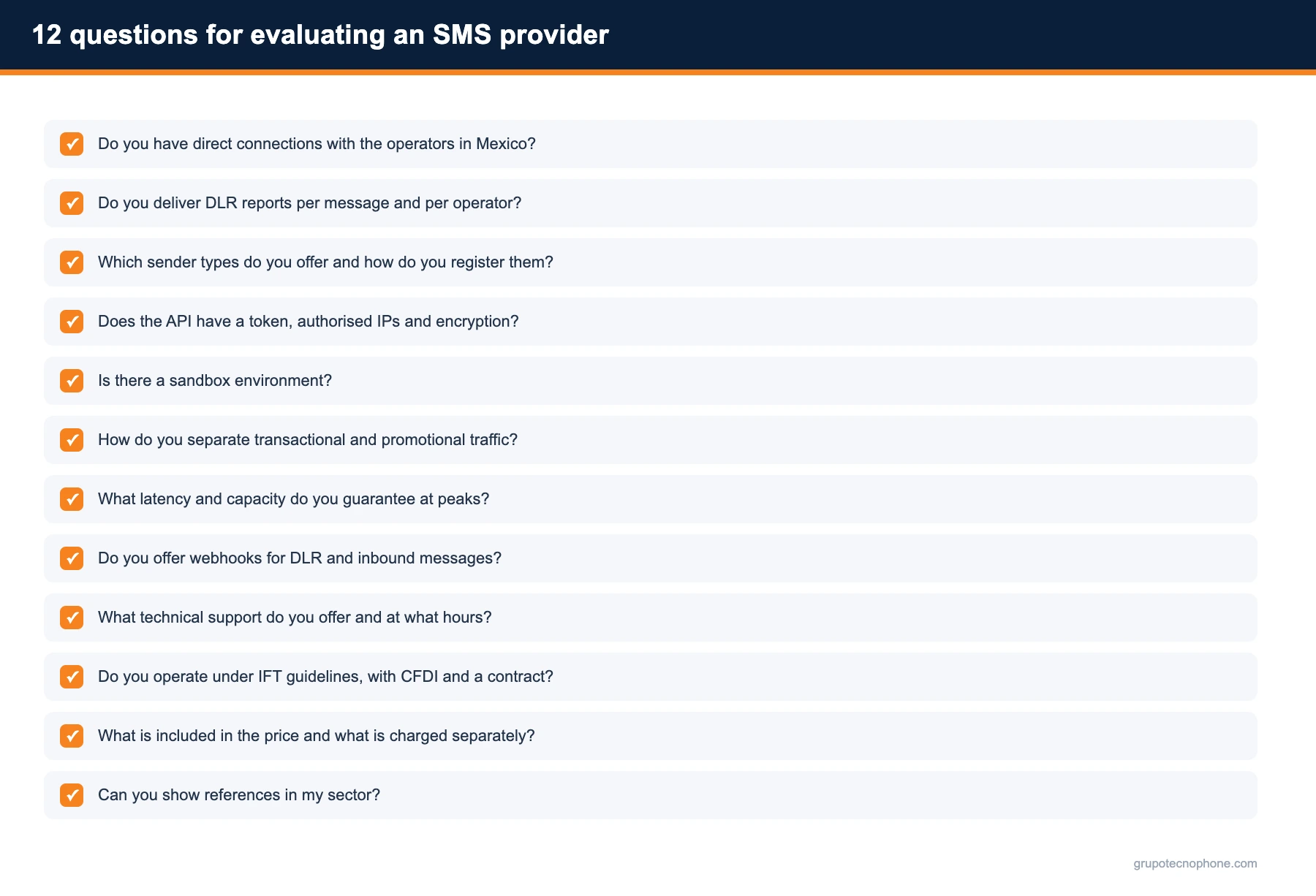
1. How much control do you have over the route and over delivery reporting in Mexico? The answer determines deliverability, latency and report quality. Ask for the detail operator by operator.
2. Do you provide per-message delivery reports (DLR) with status, date, time and operator? Without DLRs there is no way to know what arrived or to handle complaints.
3. What latency and what capacity do you guarantee at traffic peaks? Ask about route redundancy and how transactional traffic is prioritised over bulk.
4. Which sender types do you offer (alphanumeric, short code, long number) and how do you handle registration with each operator? Ask them to tell you what the customer will see on each network.
Functionality and integration
5. What is the API like: REST over HTTPS, with public documentation and code examples? Is there a sandbox environment for testing without sending real messages?
6. Do you offer webhooks to receive delivery reports and inbound messages (MO) in real time in my system?
7. Can transactional and promotional traffic be separated into different projects or connections, each with its own senders, users and reporting?
8. Does the web console let me upload lists, personalise variables, schedule sends and export reports without writing code?
Security and compliance
9. What security controls does the API have: token authentication, an authorised IP list, optional content encryption? And the console: multi-factor authentication, device validation, IP restriction, per-user permissions?
10. Do you comply with the current regulatory framework (CRT, PROFECO and personal data protection), honour exclusion lists, issue CFDI invoices and sign formal contracts? For banking and government this is not optional.
Service and terms
11. What technical support do you offer, at what hours and through which channel? Do you support the integration itself? A provider that only answers tickets during office hours is no use for critical traffic.
12. What is included in the price and what is charged separately? Ask about segments, failed messages, reports, webhooks, encryption, senders, support and minimum spend. And ask for references in your own sector.
Grupo Tecnophone answers all twelve with its own infrastructure in Mexico, per-message reporting, an API with sandbox and encryption, a console with MFA, and formal contracts and invoicing. See for yourself: request a demo or talk to an expert from the contact page.
Sources
- “Inicia funciones la CRT, nuevo regulador en telecomunicaciones”, La Jornada, October 19, 2025. Read article
- “3GPP TS 23.040: Technical realization of the Short Message Service (SMS)”, ETSI / 3GPP. Read source
- “Preguntas frecuentes del Registro Público para Evitar Publicidad (REPEP)”, PROFECO. Read source
- “Digital Identity Guidelines: Authentication and Authenticator Management (SP 800-63B-4)”, NIST. Read source
Frequently asked questions
Need an enterprise SMS platform?
Grupo Tecnophone provides enterprise SMS messaging in Mexico, an API with sandbox and encryption, per-message delivery reports and a console for campaigns. Talk to an expert or read the developer documentation.