
The price per SMS is only part of the cost. Here is what determines it in Mexico (segments, sender, volume and quality of service) and how to spend less without losing deliverability.
Why there is no single price
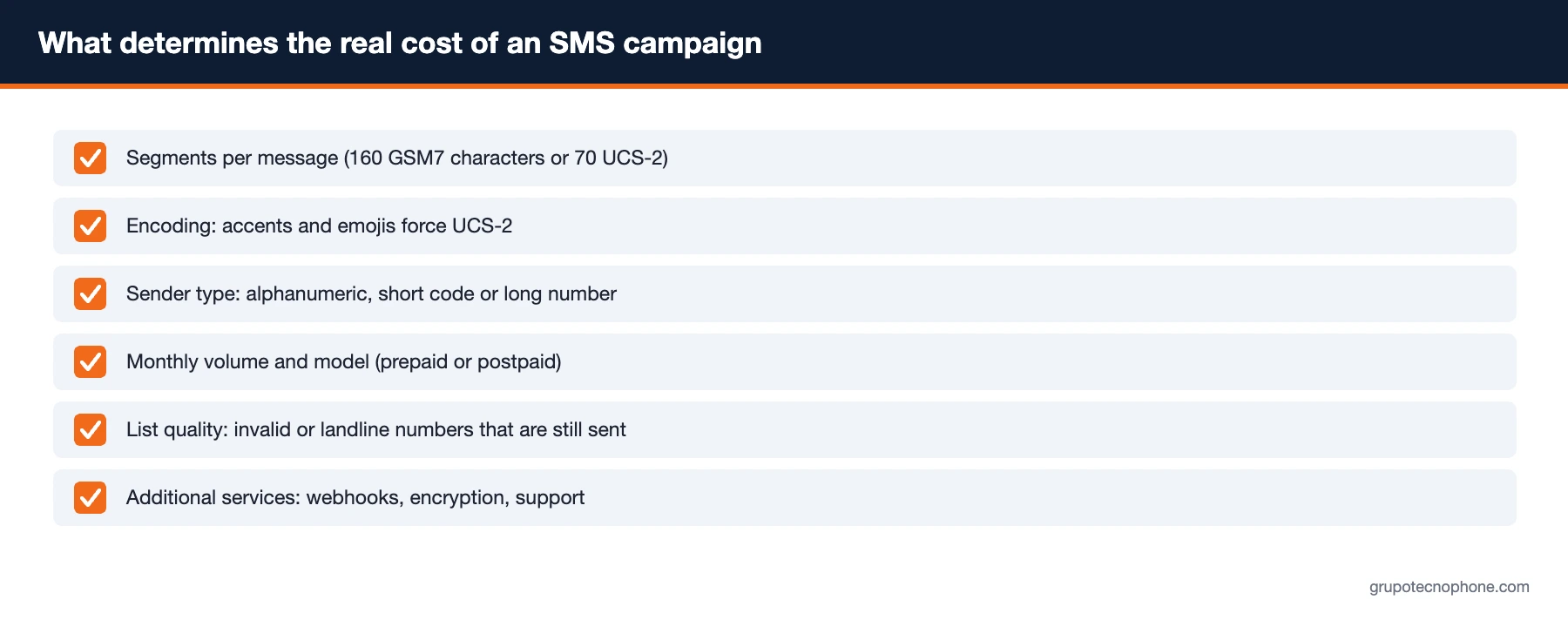
The most frequent question when evaluating a provider is how much an SMS costs. The honest answer is: it depends on how many segments it takes, which sender it goes out with, what monthly volume is contracted and under which commercial model. Two companies sending the same number of messages can pay very different amounts because of differences that never show up in the unit rate.
Above all, there is no single price because not every provider offers the same quality of service. At Grupo Tecnophone, our top-tier architecture lets us deliver an outstanding service that goes beyond sending:
- Expert advice and specialised support, with priority attention when your operation needs it.
- Real-time reports to follow every send and every campaign as it happens.
- Custom development to make integration with your systems easier and to keep improving the platform.
So when you compare proposals, compare what is included too: two similar rates can hide very different levels of service.
This article explains each factor so you can compare proposals properly and, above all, cut cost without sacrificing delivery.
Segments: the silent multiplier
Pricing is per segment, not per message. A segment is 160 characters if the text uses only the GSM7 alphabet (basic letters, digits, common symbols and a few characters such as ñ or é) and 70 characters if it needs UCS-2, which happens as soon as an accent such as á, í, ó or ú, or an emoji appears. A 120-character text with a single á takes two segments and costs twice as much.
At Grupo Tecnophone you decide which encoding to use and avoid unexpected costs. If you choose to send in GSM7, each segment holds 160 characters and the platform automatically replaces unsupported characters with compatible equivalents (for example, á with a), so an accent or an emoji never doubles the cost of a send. The platform also reports the encoding and the segment count for every message, both in the API response (encoding and num_segments fields) and in the console preview.
Sender type
An alphanumeric sender carrying the brand name may require registration with each operator. A dedicated short code involves a monthly cost and a process lasting weeks, in exchange for reply capability and high volume. The sender does not change the per-segment price itself, but it does change the fixed cost of the operation. We compare the three options in a separate article.
Volume and commercial model

Rates step down with monthly volume: the more traffic, the lower the unit price. Prepaid (you top up credit and consume it) suits variable volumes or getting started; postpaid with a contract suits stable, large operations. On prepaid, the platform rejects messages when credit runs short (INSUFFICIENT_BALANCE error), so it is worth monitoring the balance and configuring alerts.
Always ask whether there is a charge for delivery reports, webhooks, encryption or support. At Grupo Tecnophone, reports, webhooks and encryption are part of the platform.
What you get with every SMS: advantages that don’t show up in the rate

Comparing only the unit price leaves out what makes SMS the backup channel for critical communications. These are the advantages worth weighing:
- Works without internet. It travels over the cellular network: no mobile data or wifi needed, and it reaches any phone, from a high-end smartphone to a basic handset.
- No app required. Nothing to download and no account to create: the message lands in the native inbox and on the device screen, with its notification.
- Holds up when networks are congested. It is the service that uses the least network capacity. That is why, in emergencies and disasters, people are advised to text instead of calling: texts often get through when a call does not.
- Flash SMS for urgent messages. It appears directly on the screen, without the user opening the inbox, and must be seen to be dismissed, on handsets that support it. Depending on the model, it can then be saved as a regular SMS.
- Two-way. Customers can reply: confirm an appointment, approve a transaction or opt out. See how to use two-way SMS.
- Trackable links. With tracked short links you know who opened the link and when, and you measure each campaign beyond delivery.
- Sender IDs that build trust. An alphanumeric sender ID with your brand name tells customers who is writing before they open the message.
- Per-message delivery reports. Delivery reports (DLRs) and webhooks tell you which message was delivered, when and, if it was not, why.
- Blacklists and exclusion lists. Numbers that asked not to receive messages are blocked on the platform: you honour the opt-out and do not pay for sends you should not make.
That mix of reach, immediacy and traceability is why SMS is the channel of choice for messaging that cannot fail: sending OTP codes and serving as the fallback when an app, email or chat notification does not get through.
How to cut cost without losing delivery
- Write messages without accents or emojis where the content allows it, or let the platform normalise to GSM7.
- Keep every message within one segment; if you need more, question whether it is really necessary. See the SMS character limit.
- Clean the list using the reports: every invalid number you send to is money lost. See why an SMS is not delivered.
- Validate numbers before sending. At Grupo Tecnophone we check every number against Mexico’s National Numbering Plan (PNN) to tell whether it is a landline or a mobile: a landline cannot receive SMS, so it is filtered out before sending and you do not pay for messages that were never going to arrive.
- Segment: fewer, better-targeted messages outperform sending to the whole base.
- Separate transactional from promotional traffic and measure each one.
- Negotiate on real volume, using data from your own reports over the last few months.
If you want a quote matched to your volume and traffic type, write to us from the contact page with an estimate of monthly messages and the use case.
See also: Bulk SMS for business in Mexico: guide and best practices
Sources
- 3GPP TS 23.038, Alphabets and language-specific information (GSM 7-bit default alphabet and UCS-2 encoding). 3gpp.org
- Fundamental Technical Numbering Plan (Plan Técnico Fundamental de Numeración), Diario Oficial de la Federación, May 11, 2018 (in Spanish). dof.gob.mx
- Telecommunications Regulatory Commission (CRT), Fundamental Technical Numbering Plan (in Spanish). View page
- Meta, “Pricing updates for service and utility messages”, WhatsApp Business Platform documentation (changes effective October 1, 2026). developers.facebook.com
- Federal Communications Commission (US), “Tips for Communicating in an Emergency”. fcc.gov
Frequently asked questions
Need an enterprise SMS platform?
Grupo Tecnophone provides enterprise SMS messaging in Mexico, an API with sandbox and encryption, per-message delivery reports and a console for campaigns. Talk to an expert or read the developer documentation.