
For a bank, SMS is both a security layer and a service channel. Here are the use cases, the traceability and security requirements, and how to integrate it with the core banking system.
For notices before a loan or card payment is due, see 20 payment reminder SMS examples.
SMS in Mexican banking: security and service at once
Few sectors depend on SMS as much as banking. It is the channel that carries the code to authorise a transfer, the alert that someone used the card, the notice that a loan payment is due tomorrow. It works on any handset, needs no app or data plan, and the customer reads it within seconds. That is why it remains the de facto standard for authentication and notifications, even where richer digital channels exist.
The trade-off is the demand it places on the provider: a bank needs every message to be traceable, the infrastructure to withstand traffic peaks at payday or month end, and sensitive information to travel protected. This article covers the use cases and what to require from the platform.
Main use cases
- OTP authentication: online banking login, transfer authorisation, adding beneficiary accounts, changes to contact details.
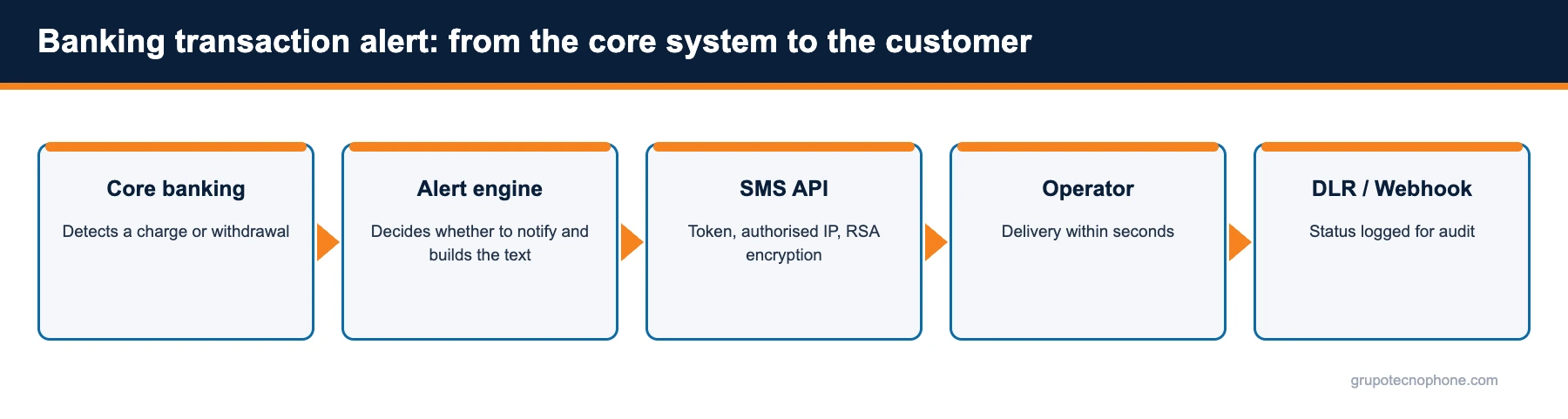
- Transaction alerts: card purchases, ATM withdrawals, transfers sent and received, unrecognised charges. They are the main early fraud detection tool in the customer hands.
- Preventive collections: reminders before the due date, minimum payment notices, payment received confirmations. They reduce delinquency without an agent getting involved.
- Regulatory and service communications: changes to terms, maintenance notices, statement availability notifications.
- Digital onboarding: number verification when opening an account, card activation, welcome messages with next steps.
Each case has a different urgency and volume profile. OTP demands latency measured in seconds; collections tolerate time-window scheduling; alerts combine both and fire thousands of times per minute at peak.

Security requirements for a banking platform
API access must be protected by token, restricted to authorised IPs and, for sensitive content, encrypted at application level on top of HTTPS transport. The Grupo Tecnophone API offers optional encryption of the destination number and the message body with RSA-OAEP-SHA256, so that not even an intermediate log exposes customer data.
Access to the web console must require multi-factor authentication, password policies, device validation and IP restriction, with users and permissions differentiated by area: whoever runs collections campaigns does not need to see the configuration of the OTP connections. And every action must be logged.
Traceability: from request to delivery report
For audit and complaint handling, every message must be traceable end to end: the request from your system, the identifier assigned by the platform (sid), the operator identifier, the final status (delivered, failed, expired) with date and time, and the destination operator. That information must be available in the console, exportable to CSV and deliverable in real time to your systems via webhook.
With that data, a complaint of the kind “I never got the alert” is resolved in minutes: you look up the sid, read the operator report and determine whether the message was delivered, failed because the number was inactive, or expired because the handset was off.
Integration with the core banking system
Integration is done through a REST API: the bank alert engine or authentication system makes one HTTPS request per message, with the number and the text (encrypted if the connection requires it), and receives an identifier. A sandbox environment validates the whole logic without sending real messages, which lets you complete integration and security testing before touching production.
For collections traffic and campaigns, the web console lets you upload segmented lists, personalise variables (name, amount, due date), schedule sends within permitted hours and measure results by campaign. Both traffic types coexist in separate projects with independent reporting and balances.
Capacity and continuity
A bank cannot afford delayed alerts on payday. The platform must run on redundant routing, with redundancy and enough capacity to absorb peaks without degrading the latency of critical traffic. Separating OTP and alerts onto a high-priority connection, distinct from collections, is the recommended practice.
Grupo Tecnophone operates as a company incorporated in Mexico, with CFDI invoicing, formal contracts and compliance with the current regulatory framework. If your institution is evaluating or renewing its messaging platform, take a look at the banking and financial services solution or talk to an expert from the contact page.
See also: SMS as a critical channel for banking and fintech: OTP, alerts and fallback · How to choose an SMS OTP provider in Mexico: 7 points to evaluate
Sources
- “Comunicado de prensa 32/26: Encuesta Nacional sobre Disponibilidad y Uso de Tecnologías de la Información en los Hogares (ENDUTIH) 2025”, INEGI, June 16, 2026. Read source
- “¡Hablemos de fraudes!”, CONDUSEF, revista Proteja su Dinero, March 2025. Read article
- “Reclamos por las estafas bancarias suben 31.5%”, El Informador, July 6, 2026. Read article
- “RFC 8017: PKCS #1: RSA Cryptography Specifications Version 2.2”, IETF, November 2016. Read source
Frequently asked questions
Industry solution: see how Grupo Tecnophone supports this use case in SMS for Banking and financial services.


Need an enterprise SMS platform?
Grupo Tecnophone provides enterprise SMS messaging in Mexico, an API with sandbox and encryption, per-message delivery reports and a console for campaigns. Talk to an expert or read the developer documentation.