
Bulk SMS is the sending of the same text message, or a personalized one, to hundreds or thousands of mobile phones at once from a web platform or an API. In Mexico it is used for promotions, notices and reminders because messages are read within minutes. This guide explains when to use it, what the law requires and how to do it right.
When a bulk SMS campaign makes sense
Bulk SMS works when the message is short, has immediate value for the person receiving it, and there is a time window that justifies the urgency: a promotion ending on Sunday, registration opening, a change of opening hours for every customer of one branch, a payment reminder for accounts due this week. In those cases the speed at which SMS is read has no competition.
It makes no sense when the message is long, requires no action, or the contact is not expecting to hear from you. Sending for the sake of sending is the fastest way to get opt-outs and spam reports, and that hurts the whole operation, including your transactional messages.
Bulk text messaging by industry
Each sector uses bulk SMS differently. These are the most common use cases in Mexico, each with a sample message under 160 characters.
Department stores and retail
Product launches, late-night sales, seasonal clearances and order-ready-for-pickup notices. They work best when segmented by store or purchase history. More in SMS for retail and SMS for e-commerce and retail.
[Brand]: Late-night sale today 8 to 12 pm. Up to 40% off appliances at your store. Details: [link]
Car dealerships
Service reminders by mileage or date, test-drive campaigns, recall notices and workshop appointment confirmations. Response rates are high because the customer already has a relationship with the dealership.
[Dealer]: Your car is due for its 6-month service. Book by replying YES or call [phone].
Collection agencies
Pre-due reminders, past-due notices and payment links. Tone and timing matter as much as content. See SMS for collections, how to reduce delinquency with SMS and payment reminder templates.
[Company]: Your payment of $[amount] is due on [date]. Pay online: [link]. If you already paid, please ignore this message.
Insurance companies
Policy renewal notices, premium payment reminders, claim status updates and cross-selling campaigns. See SMS for insurance.
[Insurer]: Your car policy expires on [date]. Renew online and keep your coverage: [link]
Schools and universities
Class cancellations, enrollment and re-enrollment dates, tuition reminders and urgent notices to parents. SMS is delivered even when the recipient has no mobile data.
[School]: There will be no classes tomorrow [date] due to [reason]. Classes resume on [date].
Restaurants, beauty salons and clinics
Appointment and reservation confirmations and reminders, off-peak promotions and loyalty programs. Reminders noticeably reduce no-shows; see SMS appointment reminders.
[Business]: See you tomorrow at [time]. Reply 1 to confirm or 2 to reschedule.
Internal communications
Notices to field staff, shift changes, safety alerts and announcements. For teams without corporate email or working away from the office, SMS is the most reliable channel.
Find more ready-to-use templates in SMS message examples and templates.
Legal requirements in Mexico
Every commercial SMS communication requires the recipient to have consented to receive it. That consent must be demonstrable (a form, a contract, a checkbox at sign-up) and the message must offer a clear way to stop receiving communications. The Federal Consumer Protection Law, the Federal Law on Protection of Personal Data and the rules of the Telecommunications Regulatory Commission (CRT), which took over the IFT’s functions in October 2025, are the framework to respect; we cover them in detail in our article on SMS marketing regulations in Mexico.
On top of that, operators maintain their own content and frequency rules, and apply filters that can block traffic they consider abusive. A provider with experience in the Mexican market knows those limits and keeps a legitimate campaign from being blocked.

Technical requirements: list, sender and platform
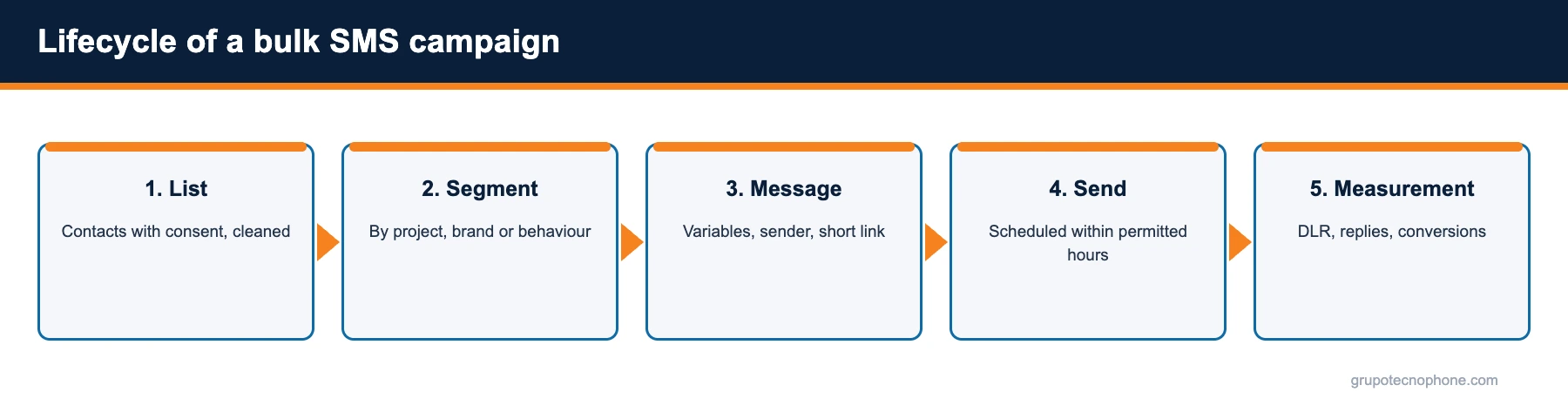
The contact list must be in a clean format (Excel or CSV) with the number in international format and the variables you want to use in the message: name, branch, amount, date. Before the first send it is worth cleaning out invalid numbers, duplicates and previous opt-outs.
The sender is the second decision: it can be a long number, a dedicated short code or, depending on the operator, an alphanumeric sender ID carrying the brand name. Each option has implications for cost, activation time and the ability to receive replies.
Finally, the platform must let you upload the list, map variables, preview the message, schedule the send, separate projects by brand or business unit, and deliver reporting by campaign and by operator. The Grupo Tecnophone console covers that whole flow with no coding required; the API is there for automated sends from your own systems.
How to write a bulk SMS that works
- Identify yourself in the first few words: the customer decides in a second whether to keep reading.
- One message, one action: one offer, one link, one deadline.
- Personalise with variables: the name and a concrete data point (amount, branch) multiply the response.
- Watch the characters: accents and emojis can turn a 160-character message into two segments and double the cost.
- Use short, trackable links if you need to measure clicks.
- Include the opt-out instruction whenever the message is commercial.
An example: “Farmacia Central: Hi Ana, your prescription is ready at the Roma branch. Collect it before Friday and get 10% off vitamins. Reply STOP to opt out.”
Timing, frequency and segmentation
Commercial messages should be sent at a reasonable hour, generally between 9am and 8pm local time, and never in the middle of the night. The platform lets you schedule the send by date and time, and spread large volumes across windows so you do not saturate the operator or your own contact centre with simultaneous replies.
On frequency, less is more: a contact who receives more than one or two commercial messages a week starts ignoring them or opting out. Segmenting by behaviour (bought recently, has not bought in three months, lives near a given branch) lets you send fewer messages and get better results.
What to measure and how to improve
Three basic metrics: delivery rate (from the operator DLR reports), reply or click rate, and conversion (purchases, payments, attributable visits). A low delivery rate points to an outdated list; a low reply rate to the message or the segment; low conversion with a good reply rate to the landing page or the offer.
Compare campaigns by operator and by segment in the platform reports, periodically clean out numbers that fail repeatedly, and test copy variants on small groups before sending to the whole base. If you need help designing your first campaign, the Grupo Tecnophone team can walk you through it; get in touch from the contact page.
See also: SMS by industry
Sources
- Federal Consumer Protection Law, current text, Chamber of Deputies (in Spanish). diputados.gob.mx
- Federal Law on Protection of Personal Data Held by Private Parties (DOF, March 20, 2025), current text, Chamber of Deputies (in Spanish). diputados.gob.mx
- Profeco, Public Registry to Avoid Advertising (REPEP) (in Spanish). repep.profeco.gob.mx
- “Telecommunications Regulatory Commission” (the CRT takes over the IFT’s functions on October 17, 2025), Wikipedia. wikipedia.org
Frequently asked questions
Need an enterprise SMS platform?
Grupo Tecnophone provides enterprise SMS messaging in Mexico, an API with sandbox and encryption, per-message delivery reports and a console for campaigns. Talk to an expert or read the developer documentation.