
In a fintech, sign-up is the moment of truth. SMS lets you verify the phone in seconds, protect every operation and warn the user before fraud goes any further.
Why SMS is critical for a fintech
A fintech competes on speed and trust. Every extra step in sign-up costs users; every fraud incident costs reputation. SMS solves both: it verifies that the person controls the phone in seconds, with nothing to install, and keeps the user informed about what is happening in their account.
Unlike traditional banks, fintechs tend to grow fast and run with small product teams. They need a simple integration, a test environment, predictable costs and a platform that scales with volume without renegotiating contracts.
Onboarding: verifying the number at sign-up
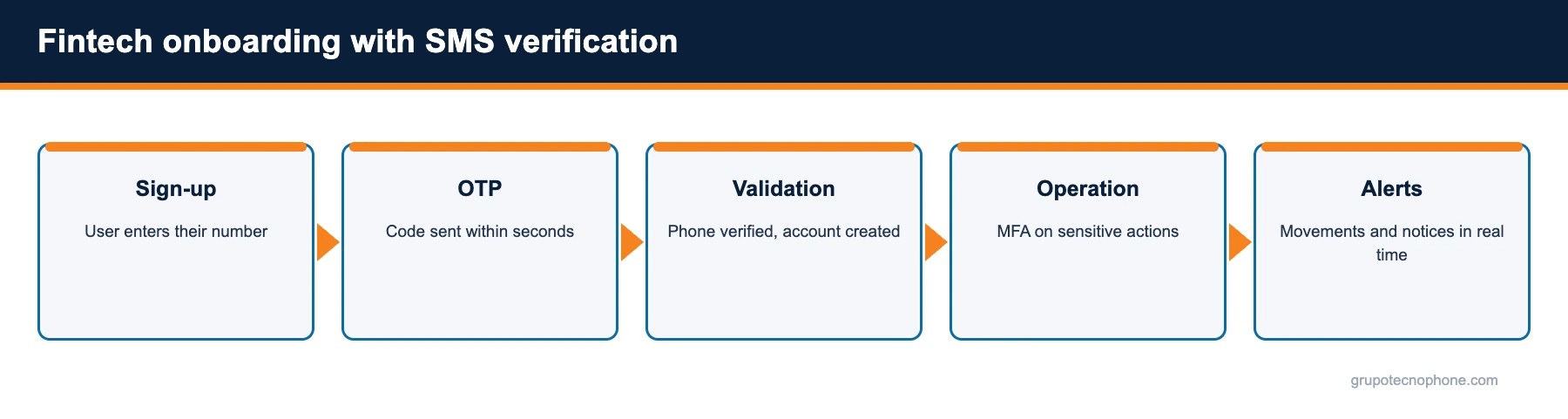
The standard flow is to ask for the phone number, send an OTP code and validate it before creating the account. Three details make the difference to conversion: send speed (the user is waiting with the screen open), message clarity (app name, visible code, warning not to share it) and the option to resend after a reasonable interval.
Verifying the phone at sign-up is also the foundation for everything that follows: account recovery, MFA and alerts. A number verified from the start prevents fake accounts and reduces support cost.
MFA and protecting sensitive operations
Once the account exists, SMS works as a second factor on risky actions: signing in from a new device, adding a beneficiary account, withdrawing funds, changing the email or phone number. The decision on when to require an OTP should be risk-based (device, amount, behaviour) so users are not fatigued by unnecessary verifications.
The code is generated and validated by your backend; the SMS platform handles delivery and reports the status back. To mitigate SIM swapping, combine the OTP with additional signals and offer an alternative factor on high-value operations.
Alerts that cut fraud and support tickets
Every meaningful movement (deposit received, transfer sent, card payment, withdrawal) should trigger an immediate notification. A user who learns of an unrecognised charge within seconds can freeze the card before the damage grows; one who does not opens a ticket days later.
Alerts also cut down on “has my money arrived yet?” enquiries. They are automated from the backend with one API call per event, and the delivery status comes back by webhook so you know the user was notified. Two-way messaging also lets the user reply to confirm or reject an operation.
Integration in minutes, not weeks
The Grupo Tecnophone API integrates with one HTTPS call per message, token authentication, an authorised IP list and code examples in PHP, Python, Node and Java. The sandbox environment validates the whole logic without sending real messages, so you can test the sign-up flow and the error cases before going live.
curl -X POST https://api.grupotecnophone.com/test/v1/sms/send \
-H "Authorization: Bearer YOUR_SANDBOX_TOKEN" \
-H "User-Agent: MyFintech-Sandbox/1.0" \
-H "Content-Type: application/json" \
-d '{"to": "+5215512345678", "body": "MyFintech: your code is 731904. Do not share it."}'
For fintechs operating in several countries, the platform has international routes in some Latin American markets; check availability and rates with your account manager.
Scaling without friction
Fintech traffic is unpredictable: an acquisition campaign can multiply sign-ups tenfold in a week. The platform runs on redundant routing, with high availability and no rigid volume contracts, so cost tracks growth.
If you are building or migrating your verification flow, take a look at the fintech solution or request technical guidance from the contact page.
Sources
- “Digital Identity Guidelines: Authentication and Authenticator Management (SP 800-63B-4)”, NIST. Read source
- “Multifactor Authentication Cheat Sheet”, OWASP. Read source
- “¡Cuidado! Alertan por nuevo fraude con el que están vaciando tu cuenta bancaria”, Expansión, February 20, 2024. Read article
- “Ley para Regular las Instituciones de Tecnología Financiera”, Cámara de Diputados. Read source
Frequently asked questions
Industry solution: see how Grupo Tecnophone supports this use case in SMS for Fintech.



Need an enterprise SMS platform?
Grupo Tecnophone provides enterprise SMS messaging in Mexico, an API with sandbox and encryption, per-message delivery reports and a console for campaigns. Talk to an expert or read the developer documentation.