
The sender is the first thing your customer sees. We compare the three options available in Mexico (alphanumeric sender ID, short code and long number) and explain which suits each type of traffic.
Why the sender matters
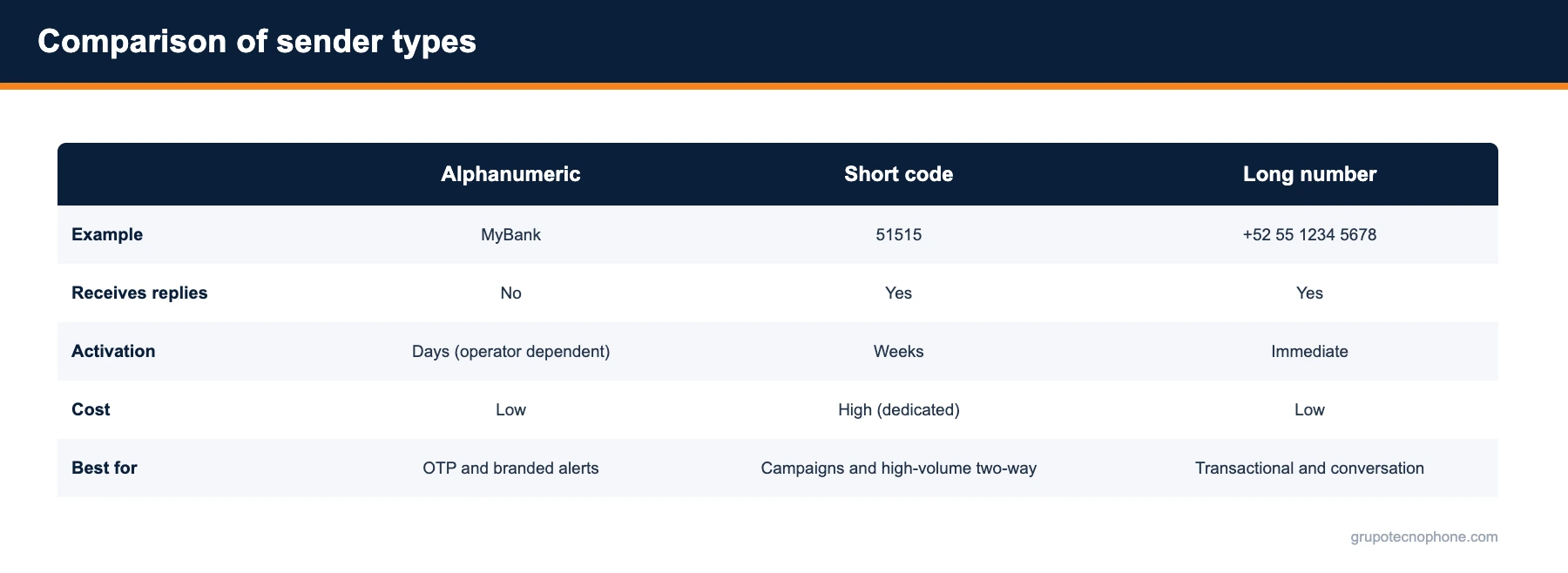
The sender ID is the name or number that appears as the origin of the SMS on the customer handset. It determines whether the message is recognised as legitimate, whether the customer can reply, how much it costs and how long it takes to activate. Choosing it well is a branding, operational and security decision all at once.
Three types exist in Mexico: the alphanumeric sender ID, the short code and the long number. Each has clear advantages and limitations worth knowing before you settle your messaging strategy.
Alphanumeric sender ID
This is a text string of up to 11 characters, normally the brand name (MyBank, StoreX). It is the most recognisable option and the one that best protects against impersonation, because the customer associates the name with the company. Its main limitation is that it accepts no replies: a customer cannot write back to a name.
Availability depends on the operator: some accept it with prior registration of the sender and others replace it with a number. That is why it pays to work with a provider that handles registration with each operator and tells you what the customer will see on each network. It is the ideal option for OTP, alerts and notifications where all that matters is the customer recognising the sender.
Why 11 characters, and what you can write
The 11-character limit is not arbitrary: it comes from the GSM standard, which reserves that space for the alphanumeric sender field in an SMS. It is a technical ceiling every operator respects, so no sender ID can exceed it.
Within those 11 characters you can use letters (upper and lower case), digits and a few basic symbols. Spaces count as a character too. What is not accepted are accents, ñ, emojis or special characters, because the field uses the reduced alphabet of the standard.
Some valid examples: MYBANK, Store X, PHARMA24, Gov CDMX. Pick a short, clear, recognisable name and always use the same one so the customer associates it with your company.
Short code
This is a four to six digit number (for example, 51515) assigned by the operators for high-volume A2P traffic. It can receive replies, supports large throughput and conveys authority. In exchange, activation is a formal process that can take weeks, it carries a monthly cost and usually requires justifying the use case to the operators.
There are shared short codes, used by several customers with different keywords, and dedicated ones, exclusive to a single company. For bulk campaigns with replies (surveys, confirmations, keyword prize draws) and for institutions that need a recognisable number, a dedicated short code is the best option.
Long number
This is a conventional ten-digit mobile number enabled for A2P traffic. It activates immediately, can receive replies and is low cost. It is the natural option for two-way transactional messaging, appointment confirmations, SMS customer service and moderate volumes.
Its limitations: it is not as recognisable as a brand name, and operators apply per-number volume limits to prevent abuse, so it is not suitable for large-scale bulk campaigns. A dedicated long number, always the same one, lets the customer save it in their contacts and recognise it.
Which to choose for your case
- OTP and security alerts: alphanumeric sender with the brand name wherever the operator allows it; a dedicated long number as the fallback.
- Transactional notifications with replies (appointments, deliveries, confirmations): dedicated long number.
- Bulk campaigns with interaction and high volume: short code, dedicated if the budget allows.
- Government and institutions: a dedicated short or long number, always the same, publicly communicated so citizens recognise it.
Many companies combine two: an alphanumeric sender for transactional traffic and a short or long number for promotional traffic. The platform lets you assign different senders per project, so each business unit or brand operates with its own.
How to request one
At Grupo Tecnophone the process starts with a request to the commercial team stating the sender type, the use case and the estimated volume. For alphanumeric senders, registration with each operator is handled for you; for short codes, allocation and enablement are arranged with the operators within their own timelines; long numbers are assigned immediately. You can start the request from the contact page.
Limitations and rules worth knowing
The alphanumeric sender comes with conditions to keep in mind. Not every operator enables it the same way: some accept it with prior registration and others, on certain routes, replace it with a number. That is why it pays to work with a provider that handles registration with each operator and tells you what the customer will see on each network.
Since it accepts no replies, it is also unsuitable for two-way flows. And like any sender, it is subject to content rules and to Mexico’s current messaging regulatory framework (CRT, the Federal Consumer Protection Law and personal data protection). Misuse can lead the operator to filter your traffic.
One security point: because the sender ID is only text, in theory anyone could try to use somebody else name. Prior registration with the operators and redundant routing are what protect your brand from a third party impersonating it.
Sources
- “SMS sender ID register: Consultation on a draft industry standard and proposed register operation”, Australian Communications and Media Authority (ACMA), March 2025. Read source
- “3GPP TS 23.040: Technical realization of the Short Message Service (SMS)”, ETSI / 3GPP. Read source
- “A partir del 3 de agosto, México tendrá una nueva forma de marcación telefónica (Comunicado 34/2019)”, IFT, July 16, 2019. Read article
- “Desaparece el IFT y nace la CRT, sin anuncio presidencial”, Expansión, October 17, 2025. Read article
Frequently asked questions
Need an enterprise SMS platform?
Grupo Tecnophone provides enterprise SMS messaging in Mexico, an API with sandbox and encryption, per-message delivery reports and a console for campaigns. Talk to an expert or read the developer documentation.