
Sending commercial SMS in Mexico is legal, but it comes with rules: demonstrable consent, a privacy notice, an opt-out mechanism and respect for exclusion lists. This guide summarises what your company has to comply with.
Why compliance matters more than it looks
SMS is a regulated channel in Mexico on several fronts: consumer protection, personal data protection and telecommunications. Non-compliance does not only expose you to fines; it also damages the sender reputation with the operators, who can filter or block traffic. And a contact base that receives unsolicited messages deteriorates fast.
This article is a practical guide, not legal advice. Every company should validate its own case with its legal team, especially in regulated sectors such as banking and insurance.
The legal framework in four pieces
The Federal Consumer Protection Law (LFPC) regulates advertising and commercial communications, and gives the Federal Consumer Protection Agency (PROFECO) authority over the Public Registry to Avoid Advertising (REPEP), where anyone can register their number to stop receiving advertising. Providers are required to honour it.
The Federal Law on Protection of Personal Data Held by Private Parties (LFPDPPP) governs the processing of a phone number as personal data: it requires a privacy notice, a stated purpose and, for marketing purposes, the consent of the data subject, who can revoke it at any time. The current law was published on March 20, 2025, and its enforcement moved from INAI to the Ministry of Anti-Corruption and Good Governance (Secretaría Anticorrupción y Buen Gobierno).
The sector regulator changed in October 2025: the Federal Telecommunications Institute (IFT) was dissolved and its regulatory powers moved to the Telecommunications Regulatory Commission (CRT), a decentralized body of the Digital Transformation and Telecommunications Agency (ATDT) created under the Law on Telecommunications and Broadcasting. The CRT regulates the operators and issues guidelines on network use, including those covering short messages, service codes and practices to prevent abuse of the channel. Operators pass those obligations on to messaging providers and their customers through their traffic policies.
Finally, sector-specific rules: banking, for example, has specific CNBV provisions on authentication and customer notifications that shape how and when certain messages are sent.

Consent: how to obtain it and how to prove it
Consent for commercial SMS must be prior, informed and demonstrable. Prior: before the first commercial message. Informed: the person knows they will receive SMS communications and for what purpose. Demonstrable: you can evidence when, how and for what it was given.
In practice this is solved with a specific checkbox on the sign-up form or in the contract (not pre-ticked), a clear clause in the privacy notice, and a record of the date, source and wording of the consent for every contact. Lists bought from third parties, or collected without this process, do not meet the requirement no matter how valid the numbers are.
Transactional versus commercial messages
Not every SMS requires marketing consent. Transactional or informational messages arising from an existing relationship (an OTP code, a purchase confirmation, a charge alert, a parcel delivery notice) rely on that relationship and on the privacy notice. What does require specific consent is any message with a commercial or promotional purpose.
The common mistake is mixing the two: adding an offer inside an informational message turns it into a commercial one. If you want to use the channel to sell, do it in separate messages and only to people who authorised it.
Obligations when sending
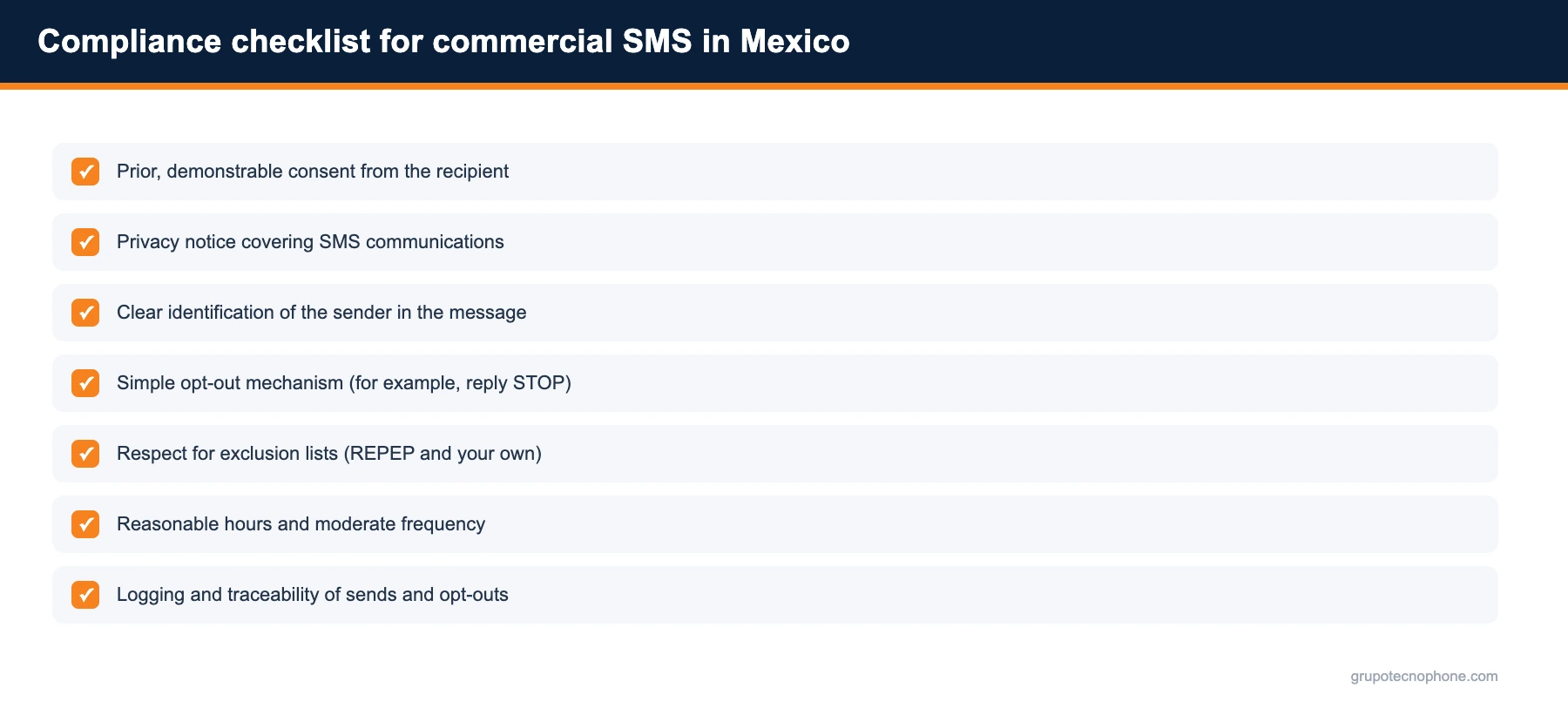
- Clearly identify the sending company in the message text.
- Offer a simple, free opt-out mechanism and honour it immediately.
- Check the list against REPEP and against your own exclusion list before every campaign.
- Respect reasonable hours and avoid abusive frequency.
- Do not use deception in the sender or the content (impersonation, false urgency, non-existent prizes).
- Keep records of sends, deliveries and opt-outs; they are your evidence if a complaint is filed.
The Grupo Tecnophone platform makes several of these obligations easier: per-project exclusion lists applied automatically, inbound opt-out replies, scheduling by time window, per-message delivery reports and full traceability of every send.
Penalties and operational risk
Fines for breaching the LFPC and the LFPDPPP can be significant and are calculated on the basis of severity and repeat offences. But the most immediate risk is usually operational: operators detect abuse patterns (high rejection rates, user complaints, misleading content) and block the sender traffic, which also affects the transactional messages you genuinely need to deliver.
Working with a provider that operates under the CRT guidelines, with clear traffic policies, is the best way to keep the channel healthy over the long term. If you have questions about your own case, you can contact the Grupo Tecnophone team.
Update (September 2026): Mexico’s CRT is preparing new anti-spam rules for SMS. We summarize what is known about the project and what to prepare.
Sources
- Federal Consumer Protection Law, current text, Chamber of Deputies (in Spanish). diputados.gob.mx
- Federal Consumer Protection Agency (Profeco), Public Registry to Avoid Advertising (REPEP) (in Spanish). repep.profeco.gob.mx
- Federal Law on Protection of Personal Data Held by Private Parties (DOF, March 20, 2025), current text, Chamber of Deputies (in Spanish). diputados.gob.mx
- KPMG Mexico, “Nueva Ley Federal de Protección de Datos Personales en Posesión de los Particulares”, April 2025 (in Spanish). kpmg.com
- Chamber of Deputies, “DOF publica decreto por el que se expide la nueva Ley de Telecomunicaciones y Radiodifusión”, July 2025 (in Spanish). diputados.gob.mx
- “Telecommunications Regulatory Commission” (creation of the CRT and dissolution of the IFT on October 17, 2025), Wikipedia. wikipedia.org
Frequently asked questions


Need an enterprise SMS platform?
Grupo Tecnophone provides enterprise SMS messaging in Mexico, an API with sandbox and encryption, per-message delivery reports and a console for campaigns. Talk to an expert or read the developer documentation.