
A2P stands for application-to-person: text messages sent by a system to people, such as codes, alerts and campaigns. Here is how it differs from person-to-person SMS and why it is the standard for businesses. In short, the A2P meaning is simple: a system, not a person, sends the message.
Definition
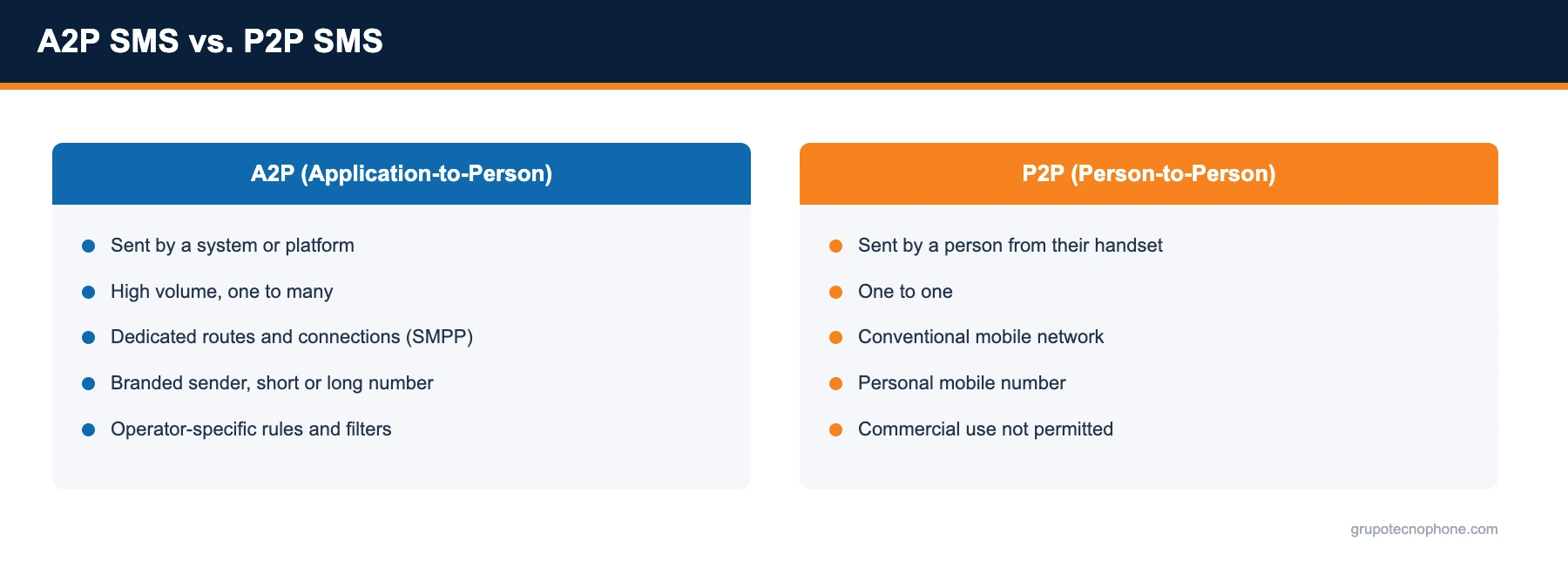
A2P stands for Application-to-Person: text messages that a system, an application or a platform sends to people. The code that arrives when you sign in, the bank alert, the delivery notice, a retailer campaign: all of that is A2P. P2P, Person-to-Person, is the ordinary SMS between two handsets.
The distinction is not merely semantic. Mobile operators treat the two traffic types differently, with their own routes, rates, rules and filters. Understanding the difference avoids delivery and compliance problems.
How A2P works technically
An A2P message does not leave a handset. It leaves a system that connects to a messaging platform through an API; the platform in turn connects to the operator message centres (SMSC) over SMPP, a protocol designed to send and receive large volumes of SMS between systems. The operator receives the message, locates the subscriber, delivers it and returns a delivery report.
This path enables what P2P cannot: volumes of thousands of messages per minute, branded sender IDs or short codes, per-message delivery reports, and security controls such as token authentication and encryption. We describe the whole journey in the article on what happens when an SMS is sent.

Why operators separate the two traffic types
Operators size and price their networks for personal use. Bulk business traffic, if it ran over P2P routes, would saturate resources and open the door to spam and fraud. That is why they require A2P traffic to come in over dedicated connections, with identified providers, registered senders and rules on content and volume.
What to check when buying A2P messaging
- That it offers delivery reports (DLR) per message and per operator.
- That it supports registered senders: alphanumeric, short code or long number, as the case requires.
- That it complies with the current regulatory framework (CRT, PROFECO and personal data protection) and operates with formal contracts and invoicing.
- That the API has security controls: token, authorised IPs, optional encryption.
- That it separates transactional from promotional traffic.
Grupo Tecnophone has more than 30 years of experience in business messaging in Mexico, for banking, fintech, retail and government.
What does A2P mean in SMS and messaging?
A2P meaning: application-to-person. In SMS, A2P refers to any text message generated by software (a core banking system, an online store, a CRM or a scheduling tool) and delivered to a person’s mobile phone. The same term is used for A2P messaging in general, across other messaging channels, but SMS remains the one that reaches every handset with no app and no data plan. When people search for “SMS A2P” or “A2P SMS” they mean the same thing: business text messages sent automatically or in bulk from a platform.
Examples of A2P SMS
Most of the business text messages you receive every week are A2P. The most common types are:
- One-time passwords and verification codes to sign in, register or confirm a transaction.
- Banking and card alerts: purchases, transfers and balance notices.
- Payment reminders and collection messages.
- Appointment reminders for clinics, workshops and public services.
- Order, shipping and delivery notifications.
- Promotions sent to customers who have opted in (see transactional vs promotional SMS).
If you need ready-to-use wording, browse our 45 SMS message examples and templates.
What is P2P SMS?
P2P (person-to-person) SMS is the message one person types on a phone and sends to another. It is conversational, low in volume and comes from a personal mobile number. Using personal lines or handsets to send business messages in bulk is not a good idea: the volume looks abnormal to network filters, the sender cannot show your brand name, and there are no per-message delivery reports to know whether each customer actually received the message.
A2P vs P2P at a glance
| A2P SMS | P2P SMS | |
|---|---|---|
| Sent by | A system or application, through an API | A person, from a mobile phone |
| Volume | From a few messages to millions per day | Low and conversational |
| Sender shown | Brand name (alphanumeric sender), short code or long number | A personal mobile number |
| Delivery reports | Per message (DLR), in real time | Not available to the sender |
| Typical uses | OTP codes, alerts, reminders, campaigns | Personal conversations |
A2P in numbers and trends
A2P traffic keeps growing, driven by authentication (OTP) and transactional notifications, even as messaging apps expand. The reason is structural: SMS is the only channel that reaches any handset with no app and no data plan, which makes it indispensable for verifying identities and for critical communications. Operators, in turn, have tightened filters against illegitimate traffic, which makes registered senders more valuable than ever.
If your company sends or plans to send SMS from its systems, take a look at the enterprise SMS messaging platform or request a demo.
If you are just getting started, it helps to understand what an SMS gateway is and how it connects your system to mobile networks.
See also: Glossary of SMS and Business Messaging Terms
Sources
- “Review of the A2P SMS termination market – Consultation”, Ofcom, January 28, 2025. Read source
- “Short Message Peer to Peer Protocol Specification v3.4”, SMPP Developers Forum, October 12, 1999. Read source
- “Ley en Materia de Telecomunicaciones y Radiodifusión”, Cámara de Diputados, July 16, 2025. Read source
- “Desaparece el IFT y nace la CRT, sin anuncio presidencial”, Expansión, October 17, 2025. Read article
Frequently asked questions



Need an enterprise SMS platform?
Grupo Tecnophone provides enterprise SMS messaging in Mexico, an API with sandbox and encryption, per-message delivery reports and a console for campaigns. Talk to an expert or read the developer documentation.