
A transactional SMS is the message your customer expects to receive: an OTP code, a payment confirmation, a delivery notice. Here is what sets it apart from promotional SMS and what that means for your operation.
What a transactional SMS is
A transactional SMS is a message sent as the direct consequence of an action or an event tied to the customer: they logged in, made a purchase, a charge hit their card, their order left the warehouse. It is not trying to sell anything; its job is to inform, confirm or authenticate. That is why the customer not only accepts it, but is waiting for it.
Typical examples are the verification code (OTP) that arrives when signing up for an app, a bank alert when cash is withdrawn from an ATM, a medical appointment confirmation, or the notice that a parcel is about to arrive. In every case the message is individual, generated automatically by a system, and has to arrive within seconds.
In practice, transactional SMS is sent through an API that connects the company system (core banking, e-commerce platform, CRM, ERP) with the messaging provider platform, which in turn hands the message to the recipient mobile operator.
What a promotional or bulk SMS is
A promotional SMS is the one the company decides to send on its own initiative to a group of customers: a weekend offer, a product launch, a loyalty programme reminder, an event invitation. It goes out in bulk, usually scheduled, and its goal is to trigger a commercial action.
Unlike transactional traffic, promotional SMS requires the recipient to have consented to receive commercial communications, and it must respect rules on timing, frequency and exclusion lists. In Mexico, the Federal Consumer Protection Law and PROFECO’s Public Registry to Avoid Advertising (REPEP) set out rules for commercial communications that are worth knowing before launching a campaign; we cover them in detail in our guide to SMS marketing regulations in Mexico.

The five differences that matter
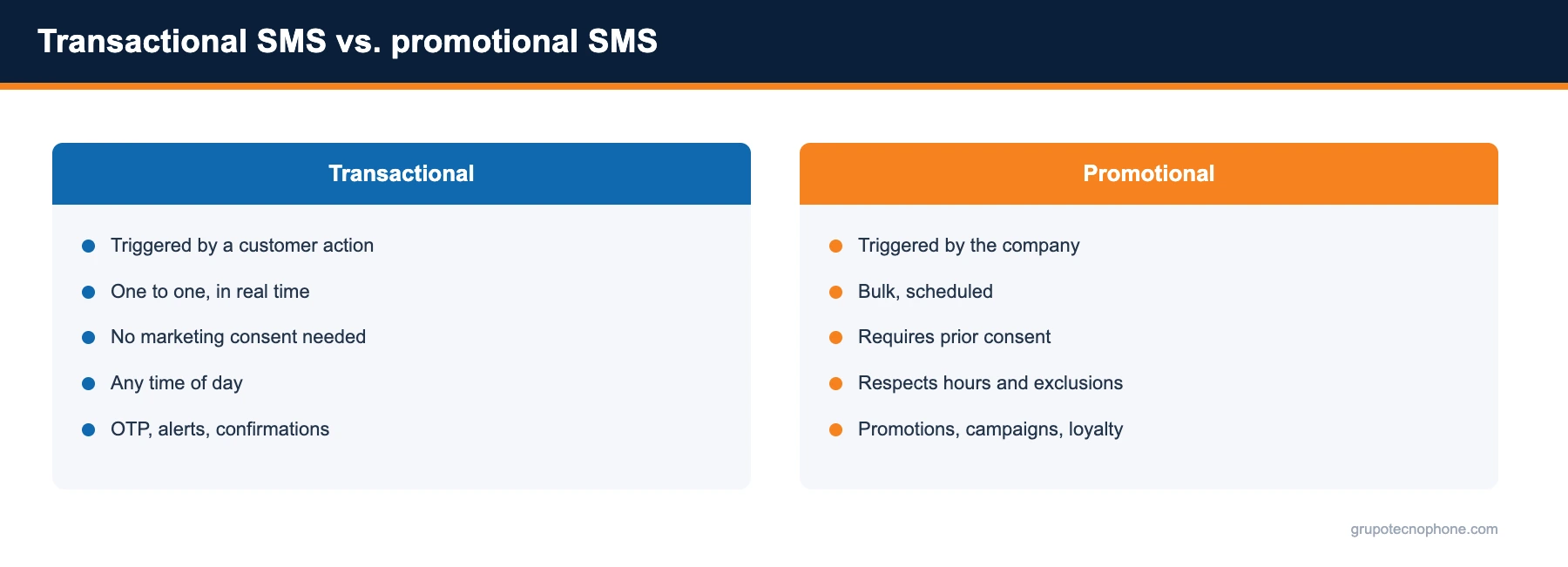
- Trigger: transactional messages are fired by a customer action or a system event; promotional ones are decided by the company.
- Volume and pace: transactional is one-to-one and in real time; promotional is bulk and scheduled.
- Consent: transactional relies on the existing customer relationship; promotional requires explicit consent for commercial purposes.
- Timing: an OTP can legitimately arrive at 3 a.m. if the customer is logging in; a promotion should not.
- Success metric: transactional is measured by latency and delivery rate; promotional by response or conversion rate.
These differences are not merely conceptual. They determine how the connection with the provider is configured, which sender type to use, how results are measured and which legal obligations apply.
Why you should separate both traffic types
Many companies start by sending everything through the same channel with the same configuration. It works until it does not: a bulk campaign of 200,000 messages can saturate the queue and delay the OTPs your customers are waiting for to access their accounts. Or a complaint about a promotional SMS can damage the reputation of the same sender ID you use for critical alerts.
The recommendation is to run transactional and promotional traffic on separate connections or projects inside the platform, each with its own sender, priority, reporting and, where relevant, budget. On the Grupo Tecnophone platform this is handled by creating independent projects per business unit, brand or traffic type, with their own users and permissions.
Examples by industry
In banking and finance, transactional traffic dominates: OTPs for login and transfer authorisation, account movement alerts, due-date notices. Promotional messaging is used carefully, only with customers who have opted in.
In retail and e-commerce both coexist: order confirmation, shipping status and purchase OTP on one side; promotions, abandoned cart and loyalty on the other. This is the sector where separating traffic matters most.
In government and public institutions almost everything is informational: civil protection alerts, notices about paperwork and appointments, payment reminders. Even when they are not strictly transactional, they are treated with the same priority because citizens need them on time.
In logistics and field services, transactional SMS is the notice that the technician is on the way, the confirmed appointment or the delivered parcel. These are the messages that cut call-centre volume the most.
What to require from your provider
For transactional traffic you need a provider with redundant routing, latency measured in seconds, per-message delivery receipts (DLR) and a stable API with a test environment. For promotional traffic you need segmentation, scheduling, per-contact variables, opt-out management and campaign-level reporting.
Grupo Tecnophone covers both cases from a single platform: a REST API to embed transactional messages in your systems, and a web console to design, schedule and measure bulk campaigns. You can learn more on the enterprise SMS messaging page or read the developer documentation.
See also: SMS for logistics · What is a flash SMS and when should your company use it
Sources
- “Ley Federal de Protección al Consumidor”, Cámara de Diputados. Read source
- “Preguntas frecuentes del Registro Público para Evitar Publicidad (REPEP)”, PROFECO. Read source
- “Short Message Peer to Peer Protocol Specification v3.4”, SMPP Developers Forum, October 12, 1999. Read source
- “Adiós al IFT: Nace la Comisión Reguladora de Telecomunicaciones, nueva autoridad del sector telecom; ¿quién la dirige?”, Expansión, October 14, 2025. Read article
Frequently asked questions



Need an enterprise SMS platform?
Grupo Tecnophone provides enterprise SMS messaging in Mexico, an API with sandbox and encryption, per-message delivery reports and a console for campaigns. Talk to an expert or read the developer documentation.