Banks and fintechs have dozens of channels available to communicate with their users, but when it comes to authentication, security alerts, or transaction confirmations, SMS remains the only one that gets through without depending on the user having the app installed, open, or a data connection. These are the use cases where SMS is still irreplaceable for the financial sector.
This article explains why SMS remains a critical channel in financial services and how to design its fallback. For specific use cases, see also SMS for banking: alerts, collections and OTP, SMS for fintech: onboarding, verification and fraud and MFA: SMS OTP, authenticator app or push.
Two-factor authentication (OTP)
The SMS code remains the most universal two-step verification method: it works on any phone, doesn’t require the user to have an authenticator app configured, and generates the least friction when onboarding a new customer. For sensitive operations (login, transfers, data changes), an SMS OTP adds a layer of security that doesn’t depend on the user’s willingness to install anything extra.
Security and fraud alerts
An unusual movement in the account, a login attempt from a new device, or a transaction above a certain amount are the kind of events where delivery time matters as much as the message itself. SMS arrives almost instantly and is read without the user needing to open any app, which makes it the reference channel for this type of alert.
Backup channel when push fails
Push notifications depend on the app being installed, the user having granted permission, and the phone having data or wifi at that moment. Any of those three conditions can fail, and in a critical use case like an access code there’s no room to try twice. Having SMS as an automatic backup channel when push isn’t delivered is what keeps an operation from getting stuck over a problem that has nothing to do with the bank.
Traceability for audits
In a regulated sector, being able to show when a message was sent, whether it was delivered, and at what time is not a minor detail. Real-time delivery reports (DLR) and an exportable history help both to resolve user complaints and to respond to an internal or external audit.
What to ask a financial SMS provider
For critical use cases like OTP and fraud alerts, not just any SMS provider will do. It’s worth asking for: Flash SMS so the most urgent alerts appear directly on screen, an alphanumeric sender ID so the message is identified with the bank or fintech’s name instead of an unknown number, blacklists to stop retrying numbers that have opted out, and specialized support with priority attention for when something fails in production and there’s no room to wait.
At Grupo Tecnophone we build infrastructure specifically designed for critical messaging —OTP, alerts, and fallback— with specialized support and custom development when the use case requires it. If you want to test it with your own flow, we have a 30-day pilot available.
Sources
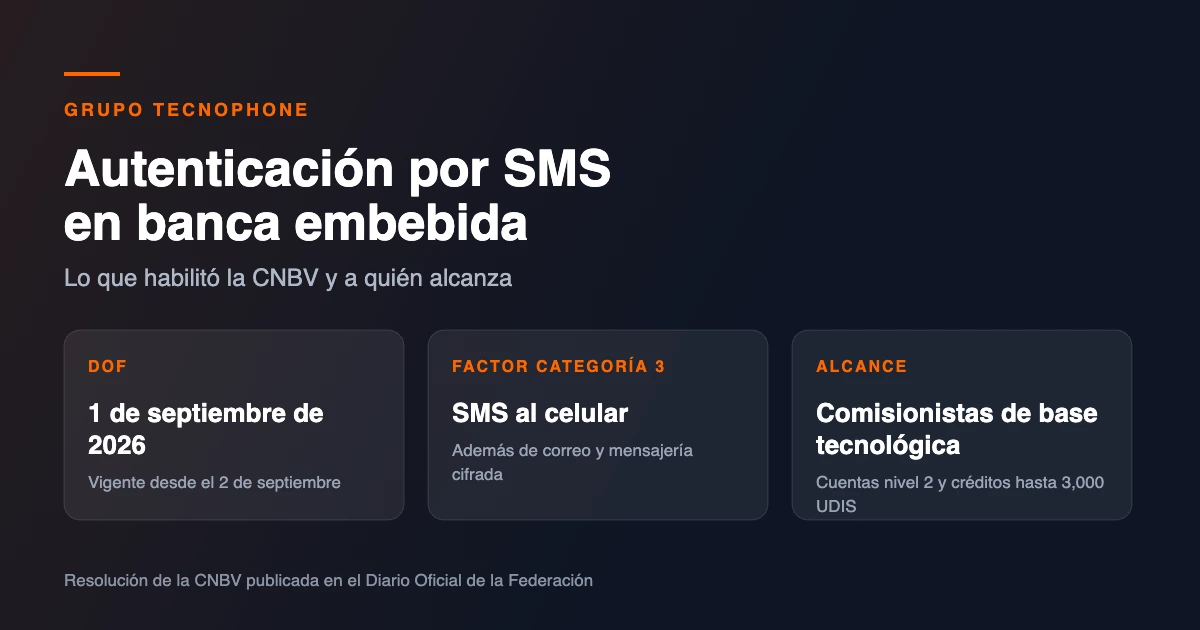
- “Te llegará un código del banco: desde mañana cambian estas reglas de autenticación”, UnoTV, September 1, 2026. Read article
- “Si tu banco te manda un código por SMS, no te asustes, es para comprobar que eres tú: llegan nuevas reglas de autenticación”, Xataka México, September 3, 2026. Read article
- “3GPP TS 23.038: Alphabets and language-specific information”, ETSI / 3GPP. Read source
- “Digital Identity Guidelines: Authentication and Authenticator Management (SP 800-63B-4)”, NIST. Read source