
Every two weeks, Mexico suspends mobile lines that have not been linked to a CURP. For a company that sends OTPs, alerts or campaigns, that means phone numbers that stop receiving messages overnight. Here is what to review before each deadline.
The calendar: which numbers are due and when
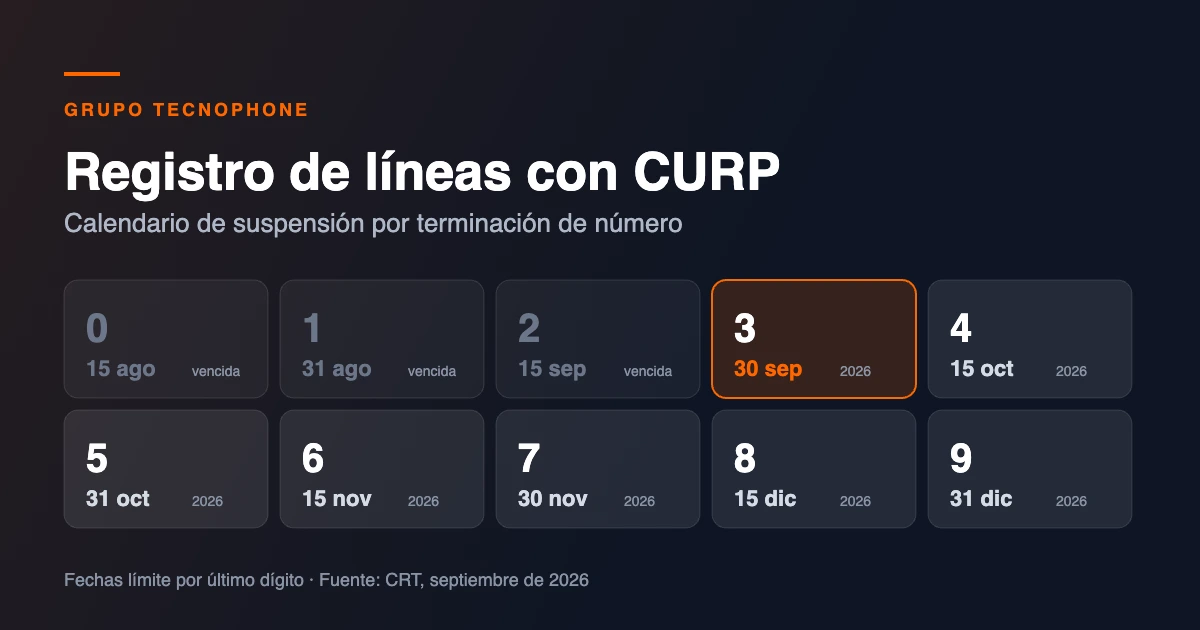
Mexico’s Telecommunications Regulatory Commission (Comisión Reguladora de Telecomunicaciones, CRT) staggered the registration by the last digit of the phone number. Numbers ending in 0 through 3 are already past their deadline (the last of them on September 30, 2026), and the next one is October 15, for numbers ending in 4.
| Last digit of the number | Registration deadline |
|---|---|
| 0 | August 15, 2026 |
| 1 | August 31, 2026 |
| 2 | September 15, 2026 |
| 3 | September 30, 2026 |
| 4 | October 15, 2026 |
| 5 | October 31, 2026 |
| 6 | November 15, 2026 |
| 7 | November 30, 2026 |
| 8 | December 15, 2026 |
| 9 | December 31, 2026 |
Updated October 1, 2026. As of September 19, the CRT reported 86,561,385 linked lines, 72.1% of the expected registry, which excludes about 25 million inactive lines that will be purged. In the block of numbers ending in 2, 9.4 million lines were linked, 82.2% of the expected total. The deadline for numbers ending in 3 passed on September 30, so suspensions for that block take effect in the first days of October. At the deadline for numbers ending in 2, more than 4.5 million lines were out of service as of September 19, and about 1.2 million were reactivated over the following days once their owners registered. In other words: each deadline leaves millions of numbers out of service for days, most deadlines fall between October and December, and a significant share of the registry is still pending.
What happens to a line that was not registered
- The carrier suspends it within 72 hours of its deadline.
- During the suspension, only emergency calls are available.
- The line does not receive messages: no OTP codes, no transactional alerts, no campaigns.
- Once registration is completed, service is restored and the user keeps the number.

What this looks like in your operation
In the days after each deadline, delivery failures cluster instead of spreading at random. A suspended number does not bounce like a nonexistent one: depending on the carrier, the message may be held or discarded, and the delivery report shows it as undelivered. If your company sends OTPs, the effect is immediate: the customer does not get the code and cannot complete the transaction, even though your integration is working correctly. Review your delivery reports and the causes of non-delivery and, in parallel, the verification rate of your OTP authentication flows.
What to do before each deadline
- Put the remaining dates on your operations calendar: October 15 and 31, November 15 and 30, December 15 and 31.
- Segment your database by last digit to know how many numbers are at risk in each two-week window. It is the same criterion the regulator uses, and it gives you a simple forecast of the affected volume.
- Monitor delivery reports for the three days after each deadline and compare them with your average.
- Define a fallback plan for OTPs: a voice retry, verification through another channel, or contact with support. Customers should never be left without a way forward.
- Limit retries. After two or three failed attempts, quarantine the number instead of paying for messages that do not arrive.
- Clean your database carefully: a number with sustained failures over several weeks is a candidate for removal, but a registration suspension is reversible.
Your company’s lines must be registered too
If your organization has mobile lines in the company’s name, they are part of the same registry. Legal entities register with their carrier using their RFC (tax ID) and the legal representative’s ID or e.firma, and there is no general cap on the number of lines. Use the process to update your inventory of corporate lines: which are still in use, who has them, and which should be canceled.
Watch out for fake SMS that use the registration as bait
Along with the registration came messages and pages that impersonate carriers to ask for verification codes, passwords or banking details. For a legitimate brand the problem is twofold: customers distrust every message, and your sender competes with that noise. Three practices help: always use the same sender ID, never ask for the code or credentials in the message, and publish links on your own domain instead of generic URL shorteners.
Related: Mexico’s CRT is also preparing anti-spam rules for SMS that could change how business messages are classified and filtered.
Sources
- “Registro de celulares en México: CRT revela cuántos usuarios ya hicieron la vinculación”, El Informador, September 25, 2026. Read article
- “Qué celulares dejarán de funcionar a partir de octubre si no fueron registrados”, Infobae México, September 30, 2026. Read article
- “Prórroga en registro de celulares se extiende a todo 2026; CRT fija calendario escalonado”, La Silla Rota, June 25, 2026 (in Spanish). Read article
- “Faltan por registrar 42.08% de las líneas de teléfono celular: CRT”, La Jornada, September 18, 2026 (in Spanish). Read article
- “Registro de celulares 2026: CRT da plazo de 72 horas para dejarte sin línea”, El Financiero, August 16, 2026 (in Spanish). Read article
Frequently asked questions
Need an enterprise SMS platform?
Grupo Tecnophone provides enterprise SMS messaging in Mexico, an API with sandbox and encryption, per-message delivery reports and a console for campaigns. Talk to an expert or read the developer documentation.