
SMS, WhatsApp and email do not compete: they complement each other. We compare reach, speed, cost and requirements for each channel, and give a simple rule for deciding which to use for each type of message.
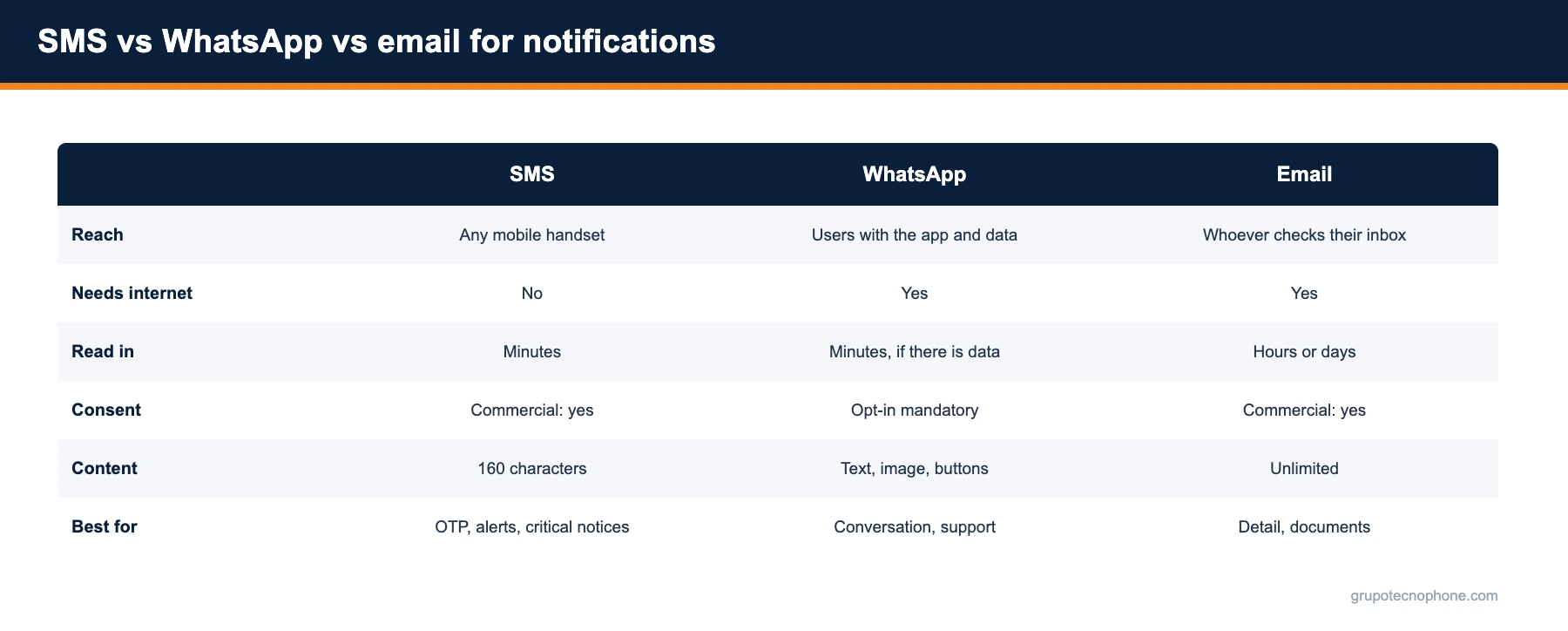
The right question is not which, but what for
Each channel has its place. Email carries detail and documents; WhatsApp allows a conversation with images and buttons; SMS reaches any handset in seconds without depending on an app or a data plan. The companies that communicate best do not pick one: they define which type of message goes through each channel.
This comparison focuses on critical notifications: the ones the customer needs to receive on time, such as an access code, a charge alert, a change to an appointment or the notice that an order has arrived.
SMS: universal reach and urgency
SMS works on any mobile handset, with or without internet, with nothing to install. It is read within minutes, it does not land in an email spam folder and it does not depend on the user having an active data connection. It is the most reliable channel for OTP, security alerts, delivery notices and institutional communications.
Its limits: 160 characters per segment (70 with á, í, ó, ú or emojis; see the SMS character limit), no images or buttons, and a per-message cost that demands judgement. Commercial messages require consent and an opt-out mechanism.
WhatsApp Business: conversation with opt-in
WhatsApp allows rich messages (images, documents, reply buttons) and real-time conversations, ideal for support, order follow-up with interaction and commercial service. Adoption in Mexico is very high, which makes it attractive.
Its requirements are stricter: the user must have given explicit opt-in, message templates must be approved in advance, sending requires the recipient to have the app and a data connection, and Meta charges per message according to the template category: marketing, utility or authentication. For OTP and critical alerts, the dependence on data connectivity is a real limitation: with no data, the message does not arrive.
Pricing change from October 1, 2026. Meta starts charging for every service message and every utility template sent within the 24-hour customer service window, which used to be free. Only messages within the 72-hour window opened by Click to WhatsApp ads remain free of delivery charges. For high-volume transactional notifications, this changes the cost comparison with SMS.
Email: detail and record
Email is the channel for anything that needs length: statements, invoices, terms and conditions, detailed confirmations. It is cheap and accepts any format. Its weakness is time: it is opened in 20-25% of cases and often hours later, on top of competing with spam.
For critical notifications it is the backup, not the primary channel: the SMS says the statement is available, the email contains it.
A practical rule for deciding
- If the message is urgent and short (code, alert, delivery notice): SMS.
- If the message starts or continues a conversation (support, follow-up with questions): WhatsApp, with opt-in.
- If the message needs detail or documents (invoice, contract, monthly summary): email.
- If the message is critical and cannot fail (OTP, security alert): SMS as the primary channel, with another as backup.
- If the recipient may have no data plan or smartphone (government, rural areas, older adults): SMS.
Many companies combine all three with cascade logic: they try the richest channel first and, if there is no delivery confirmation within a reasonable time, fall back to SMS. SMS delivery reports and webhooks are what make that logic possible.
Total cost, not cost per message
Comparing unit price alone is misleading (we explain it in how much bulk SMS costs in Mexico). An SMS costs more than an email, but an OTP that never arrives by email costs you a customer who cannot log in; a fraud alert that lands hours late costs far more than the message. The right calculation includes delivery rate, speed, support cost avoided and risk covered.
If you are designing your channel strategy, Grupo Tecnophone can help you decide which messages are worth moving to SMS and how to integrate it with your systems. Take a look at the enterprise SMS messaging platform or talk to an expert.
Sources
- Meta, “Pricing on the WhatsApp Business Platform”: per-message pricing since July 1, 2025 and template categories. developers.facebook.com
- Meta, “Pricing updates for service and utility messages”: changes effective October 1, 2026. developers.facebook.com
Frequently asked questions
Need an enterprise SMS platform?
Grupo Tecnophone provides enterprise SMS messaging in Mexico, an API with sandbox and encryption, per-message delivery reports and a console for campaigns. Talk to an expert or read the developer documentation.